

Why does my window slide down by itself?
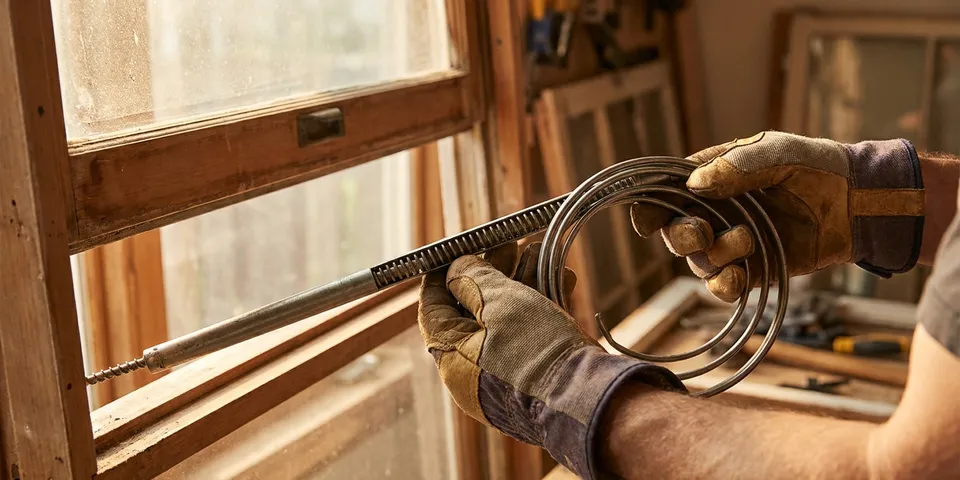
The sash balancer — the spring that holds the window's weight — has lost tension. It's a $175 mechanical repair, not a sign you need a new window.
Sounds like: window slides back down the moment you let go · sash slams shut on its own · window feels too heavy to lift on one side
A window that won't stay up has a worn sash balancer — a spring mechanism hidden in the frame, not a broken window. WowFix replaces balancers on double-hung and single-hung windows of any brand for $175 including parts and labor.
Inside each side of a double-hung window hides a balancer — a coiled spring (spiral type) or a weighted channel (block-and-tackle type) that carries the weight of the sash. Every open and close cycles that spring. After fifteen or twenty years the tension fades, and one day the window starts creeping down on its own; a season later it slams. It is the single most common window failure we see in North Carolina, and it has nothing to do with the glass, the frame, or the «age of the window».
The visit takes one stop: we tilt or lift the sash out, read the balancer spec stamped on the old unit (length, weight class, tip type), fit the matching new pair, re-tension, and set the sash back. You get both balancers on that sash replaced — they wear as a pair, and replacing one side only means a second call within a year. $175 covers the balancer, the labor, and the written 5-year warranty.
Andersen tilt-wash and builder-grade vinyl (Window World, Silver Line, MI) fail most often — their spiral balancers are lighter-gauge. Pella and Marvin use block-and-tackle channels that last longer but cost the same to swap. We stock and match specs for all of them, including lines discontinued twenty years ago.
A balancer swap is $175; replacing the window because it «won't stay open» is $1,000+ for vinyl or ~$2,000 for wood.
Honest DIY note: Replacement spiral or channel balancers sell for $10–30 online — the trap is matching the exact spec (length, gauge, tension class) and re-tensioning without dropping the sash. Most of our balancer calls start with a kit that didn't fit.
The sash balancer — the spring that holds the window's weight — has lost tension. It's a $175 mechanical repair, not a sign you need a new window.
Kits sell for $10–30 online. The catch is matching the exact spec (length, gauge, tip) and re-tensioning the spring without dropping the sash — a spring under load is how fingers get hurt. Most of our balancer calls start with a kit that didn't fit.
Almost always: $175 per balancer against $1,000+ for a new vinyl window or ~$2,000 for wood. Unless the sash itself is rotted or the glass seal has failed too, the balancer swap buys the window another decade.
You need balancers — $175 including parts and labor, and the stick retires the same day. A sash that has to be propped has lost spring tension on both sides; we swap the pair, set the tension to the sash weight, and the window holds any position again. The glass, frame and locks play no part in this failure.
Ask us to — the rest of the house is usually only a few seasons behind the window that just failed. The walkthrough also catches what most homeowners don't know is repairable: fog between the panes (a $198 unit swap) and soft sill wood (rebuilt from $375). One written sheet, priced line by line, zero obligation to act on it today.
Sash balancer calls come in from all three of our metros — Charlotte, the Raleigh–Durham Triangle and the Greensboro–Winston-Salem Triad — plus the towns around them, from Huntersville and Matthews to Cary, Apex and Kernersville. The price doesn't change with the zip code: $175 per balancer, parts + labor, any brand, written 5-year warranty.
Applies to: double-hung, single-hung. Every repair carries a written 5-year warranty.